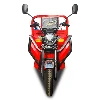
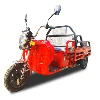
Gasoline tricycles, with their reliable power, flexible load-bearing capacity, and strong environmental adaptability, have been widely applied across multiple levels of urban and rural economic and social services, becoming a vital link between production and distribution, and services and people's livelihoods. Geographically, they are active on flat roads in plains and towns, and also capable of navigating unpaved roads in mountainous and hilly areas. They are particularly advantageous in areas with weak power grids and charging infrastructure, forming the capillaries of the grassroots transportation network.
In agricultural production, gasoline tricycles are an important carrier for the downward flow of agricultural supplies and the upward flow of agricultural products. During the spring planting season, they can transport fertilizers, seeds, pesticides, and other materials in bulk to the fields; during the harvest season, they can quickly collect and distribute grains, fruits, and vegetables from the fields to collection points or primary processing sites. Their flatbed or sideboard cargo boxes are suitable for bagged, boxed, and bulk materials, while deep-treaded tires and reinforced suspension ensure passability on muddy field ridges, significantly reducing the intensity of manual handling and improving agricultural efficiency.
Urban and rural logistics distribution is another core scenario. In the areas bordering county towns and townships, gasoline-powered tricycles, with their compact bodies, shuttle through streets and alleys, undertaking tasks such as last-mile delivery of express parcels, supermarket restocking, and transportation of building materials and auxiliary materials. Compared to four-wheeled trucks, they have fewer entry restrictions and are more flexible in parking and loading/unloading, effectively solving the "last mile" delivery problem; some models with enclosed cargo boxes can also ensure the protection needs of fresh produce and daily necessities during transportation.
They are also seen in short-distance passenger transport and public services. In tourist attractions, large factory areas, or communities not covered by urban and rural public transport, gasoline-powered tricycles modified into semi-enclosed passenger compartments can provide scheduled shuttle services, and the addition of seats and safety handrails improves the riding experience; sanitation departments convert them into sweepers or garbage collection vehicles, using the chassis to install roller brushes, cargo boxes, and other equipment to achieve integrated road cleaning and garbage transfer operations.
Furthermore, in emergency response and temporary operations, gasoline-powered tricycles are frequently used as tools and equipment transport vehicles for power repairs and communications maintenance due to their convenient refueling and rapid deployment. They are also used for transporting goods in temporary, densely populated areas such as markets and temple fairs.
In terms of functional breadth, gasoline-powered tricycles not only cover the three basic scenarios of freight, passenger transport, and special-purpose operations, but can also extend into niche areas through cargo box modifications and equipment integration. The extensibility of their application scope stems from the openness of their structure and the universality of their power source, continuously providing practical support for the operation of grassroots economic and social activities.