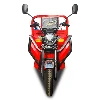
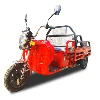
As a representative model of Chongqing Heavy Industry's quality, the Hanma tricycle, with its advantages of heavy-duty durability, powerful performance, and adaptability to various road conditions, is widely used in urban and rural freight, field operations, and short-distance transportation. The vehicle's stable output and robust performance are not the result of a single component, but rather the precise collaboration of dozens of precision parts, each performing its specific function. From power generation and transmission to steering, braking, and shock absorption, the various system components are interconnected, constructing a mature and efficient mechanical operation system. This article will deeply analyze the operational logic of the core components of the Chongqing Hanma tricycle, revealing the core secrets of its robust performance.
The power system is the "heart" of the Hanma tricycle, consisting of a gasoline engine, spark plugs, pistons, crankshaft, fuel tank, and intake and exhaust components. It is the power source for the vehicle's movement and load-bearing capacity, achieving efficient conversion of fuel energy through mechanical circulation throughout the process.
The engine, as the core power component, operates continuously according to the four-stroke working principle. During the intake stroke, the intake valve opens, and air and fuel mix before being drawn into the cylinder. During the compression stroke, the piston moves upward to compress the mixture, increasing its concentration and pressure. The power stroke is the core of the power cycle; the spark plug ignites the high-pressure mixture, and the resulting explosive force propels the piston downward at high speed, converting heat energy into mechanical kinetic energy. Finally, the exhaust stroke expels the combustion gases, completing one power cycle, continuously outputting power.
The crankshaft is a key component in power conversion, transforming the piston's linear reciprocating motion into rotational motion, providing stable rotational power to the subsequent transmission system. Designed for the heavy-duty characteristics of the Hummer tricycle, the original crankshaft uses a thickened forging process, resulting in greater load-bearing capacity and effectively preventing power loss and component deformation during heavy-duty operations. Simultaneously, the fuel tank provides a continuous and stable fuel supply, the oil pump lubricates the entire engine, and the cooling system cools the engine in real time, ensuring the engine does not overheat or stall during prolonged high-load operation, making it suitable for complex working conditions such as construction sites and rural dirt roads.
If the engine is the source of power, the transmission system is the vehicle's "blood vessels." The Hummer tricycle's transmission system comprises core components such as the gearbox, reverse gear, driveshaft, rear axle assembly, differential, and half-shafts. It is responsible for smoothly transmitting engine power to the rear wheels and performs core functions including gear shifting, reversing direction, and load adaptation, making it crucial to the vehicle's power response and load capacity.
The gearbox is the core of power regulation, internally equipped with multiple sets of precision gears. The driver switches between different gear engagement states by shifting gears, changing the transmission ratio and thus adjusting vehicle speed and torque. Low gears amplify torque to meet the power demands of heavy-load starts and hill climbing; high gears optimize transmission efficiency for smooth, constant-speed driving, perfectly matching the Hummer tricycle's "heavy-duty, commuter-friendly" positioning.
The mechanical reverse gear is a unique and practical component of the vehicle, simple in structure and extremely durable. When the reverse gear lever is engaged, the internal idler gear engages with the gears, reversing the power transmission direction and causing the rear wheels to rotate in the opposite direction, thus reversing the vehicle. This component boasts rapid response and a low failure rate, making it suitable for high-frequency scenarios such as working in confined spaces and reversing for unloading, significantly enhancing vehicle practicality.
Power is transmitted to the driveshaft via the gearbox and reverse gear, and then from the driveshaft to the rear axle assembly. As the core load-bearing component, the rear axle bears all power and the vehicle's weight, with its internal differential playing a crucial regulatory role. When the vehicle is traveling straight, the differential gears lock synchronously, ensuring the left and right rear wheels rotate at the same speed for stable driving. When the vehicle is turning, the differential planetary gears adjust autonomously, allowing the outer rear wheel to rotate at a higher speed than the inner rear wheel, avoiding tire wear and vehicle jerking issues, and improving steering agility. Finally, power is transmitted to the left and right wheel hubs via the half-shafts, driving the wheels to rotate and completing the closed-loop power transmission system.
The Akhal-Teke Hummer tricycle employs a vertical steering structure, with the steering spindle featuring a combination of upper and lower double bearings. The bearing seats are precisely fixed within the housing structure, effectively reducing steering friction resistance. When the driver turns the handlebars, torque is transmitted to the steering spindle via the steering column, causing the front wheel bracket to rotate synchronously, achieving direction switching. The dual-bearing structure effectively counteracts steering vibrations caused by bumpy road conditions, preventing directional drift and resulting in light and precise steering. Even during extended operation, it is less prone to steering jerking or veering. Simultaneously, the entire steering component is well-sealed, resisting the intrusion of field mud and construction dust, reducing component wear and enhancing durability.
The parking brake component locks the vehicle at rest. Engaging the parking brake after parking secures the brake gears to the wheel hub, preventing vehicle slippage. This is particularly suitable for parking on slopes and unloading scenarios, providing comprehensive operational safety. The entire braking system features a simple structure, low failure rate, and easy maintenance and replacement, meeting the practical needs of engineering and agricultural vehicles.
The hydraulic shock absorber is the core component for cushioning and damping vibrations, consisting of a cylinder, piston, piston rod, and damping fluid. When the vehicle travels over bumpy roads, the impact force pushes the piston rod to compress the cylinder. The internal fluid flows slowly through small valves, using damping to absorb and dissipate the impact force. When the road surface is smooth, the fluid flows back, pushing the piston rod back to its original position, quickly smoothing out vehicle vibrations. Compared to ordinary shock absorption structures, hydraulic shock absorbers provide a gentler cushioning, effectively filtering bumps and protecting the frame, engine, and transmission components from vibration damage, thus extending the overall lifespan of the vehicle.
The core advantage of the Chongqing Hanxue Hummer tricycle lies in the high degree of compatibility and precise coordination of its various system components. The engine outputs power, the transmission system precisely transmits and regulates power, the control system accurately guides the driving direction, the braking system provides real-time protection, and the shock absorption system buffers road impacts and stabilizes the vehicle body. These five systems complement each other and operate in a closed loop.