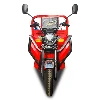
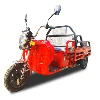
The structural design of gasoline tricycles revolves around "load-bearing practicality and ease of operation." Through the coordinated operation of four major systems-power, transmission, locomotive, and load-bearing-a functional system adaptable to complex road conditions is constructed, providing crucial support for their ability to perform diverse tasks in urban and rural areas.
The power system is the core energy source, typically employing a single-cylinder or twin-cylinder air-cooled gasoline engine with a displacement ranging from 150cc to 300cc. It features low-speed, high-torque characteristics, stably outputting the traction force required for a load of 0.8-2.5 tons. The engine achieves fuel-air mixture control through a carburetor or electronic fuel injection system, coupled with a simple starting device (such as a pedal or electric starter) to ensure reliable ignition in low-temperature and bumpy environments.
The transmission system is responsible for power transmission, commonly featuring a direct-drive architecture of "engine-clutch-gearbox-rear axle." The clutch is mostly a dry, single-plate type, ensuring smooth starting; the transmission is mostly a 3-5 speed manual, with some models featuring a reverse gear to adapt to forward and reverse driving scenarios; the rear axle integrates the main reducer and differential function, efficiently distributing power to one wheel for improved cornering agility.
The running gear consists of the front fork, rear suspension, and wheels. The front fork often uses a hydraulic damping structure to absorb road bumps; the rear suspension is mostly a leaf spring or solid axle design, enhancing vehicle stability under heavy loads; wheel configurations vary depending on the application, with freight vehicles commonly using 16-18 inch deep-tread tires for enhanced grip, while passenger vehicles prioritize comfort and use wide-tread tires.
The load-bearing system focuses on functionality, with open flatbed or sidecar cargo boxes being the mainstream, their dimensions adjustable to meet load requirements. Some models are equipped with tarpaulin supports or removable side panels, balancing cargo protection and loading/unloading convenience; a few passenger models use a semi-enclosed cab, adding seats and simple doors and windows to improve passenger comfort.
The various systems are organically integrated through a rigid frame to form a compact and torsional-resistant structural layout that meets the load-bearing strength requirements while retaining the flexibility to turn on narrow roads, providing a solid mechanical foundation for gasoline tricycles in various application scenarios.