Lower running costs, zero tailpipe emissions and simpler maintenance are pushing battery-powered cargo trikes from niche option to default choice in short-haul logistics
CHONGQING, China, November 12, 2026 - For a category that rarely makes headlines, the electric three-wheeler has quietly become one of the most consequential vehicles in emerging-market logistics. Small enough for an alley, cheap enough for a market trader, and able to carry several hundred kilograms, it does the work that neither a bicycle nor a light truck can do economically. As fuel-powered models face tightening restrictions in a growing number of Chinese cities and rural delivery volumes keep rising, the case for going electric has moved from environmental preference to straightforward business arithmetic.
The running-cost argument comes first
Ask an operator why they switched and the answer is usually money. A battery-electric drivetrain replaces the engine, gearbox, clutch, exhaust and lubrication system with a motor, a controller and a battery pack. Energy becomes electricity rather than petrol - typically a fraction of the per-kilometre fuel cost - and the maintenance list shrinks accordingly: no oil changes, no spark plugs, no filters, no exhaust repairs.
The savings compound for high-utilisation vehicles. A cargo trike doing 60 to 100 kilometres a day in market deliveries or farm-to-collection-point transport is exactly the duty cycle where energy and servicing costs dominate total cost of ownership. For a small business working on thin margins, that difference is often what makes the vehicle pay for itself.
The counterweight is the battery. It is the single most expensive component, and buyers should look closely at chemistry, warranted cycle life and the real cost of replacement before comparing sticker prices.
Zero tailpipe emissions, and quieter streets
Electric three-wheelers produce no exhaust emissions at the point of use, which matters most where vehicles and people share tight space: wholesale markets, residential lanes, food streets, warehouse yards and semi-enclosed loading areas. Replacing diesel and petrol trikes in these settings delivers an air-quality benefit exactly where exposure is highest.
Noise is the underrated half of the same story. Electric drivetrains are markedly quieter at low speed, which allows early-morning and late-night deliveries in dense neighbourhoods without the complaints that engine noise attracts - a practical advantage in any city that regulates delivery hours.
Built for the last mile, not the motorway
The three-wheeler's geometry is its advantage. A body around one metre wide with a tight turning circle fits lanes, courtyards and village roads that a light truck cannot enter, while carrying loads that would overwhelm a two-wheeler. Design speeds in the 40–50 km/h range are matched to the job: short trips, frequent stops, low average speed.
Cargo bodies are configurable - flatbed, drop-side, tipper, box van - which lets one platform serve farm produce, building materials, packaged goods, bottled water and market waste. For passenger versions, the same chassis supports three-seat configurations for short-distance shuttle work.
Parking and access follow from size. In dense urban markets, the ability to load and unload curbside without blocking a lane is worth as much as the payload rating.
Fewer parts, less downtime
Simplicity pays in uptime. With no combustion engine, there is no oil to change, no timing components, no emission-control hardware to fail. Electric motors are largely maintenance-free over their service life, and regenerative braking reduces wear on friction brakes.
Downtime, not fuel, is what actually stops a small operator earning. That makes two things decisive: the availability of spare parts, and the density of service points. A brand with a local dealer and a stocked parts channel is worth more to a working vehicle than a marginally lower price.
Policy is pushing in the same direction
Several forces are aligned. A growing number of Chinese cities restrict or ban fuel-powered three-wheelers in urban areas while permitting electric equivalents. New-energy vehicle promotion programmes aimed at rural buyers have lowered the entry cost. And type-approval rules now bring three-wheeled motorcycles into the formal announcement system, which means vehicles can be registered, insured and legally driven - a prerequisite for professional, rather than informal, operation.
Together these shift the calculation from "should I switch" to "how quickly can I switch."
What buyers should check before switching
The category is not uniform, and the differences matter:
Homologation. Confirm the model appears in the MIIT announcement catalogue. A vehicle that cannot be registered is not a cheap vehicle; it is an unusable one.
Real payload. Rated capacity should be matched to actual duty, including gradients and habitual overloading, which is common in agricultural and construction use.
Battery terms. Chemistry, warranted cycles, and replacement cost - not just nominal range.
Braking and safety equipment. Many entry-level models still use drum brakes without ABS; wet-road stopping distance deserves scrutiny.
Service reach. Parts availability and dealer proximity in the operator's own county.
Charging. Overnight 220V charging suits most single-shift operations; multi-shift fleets need a different plan.
The manufacturing response
Chinese manufacturers have spent the past decade adapting these vehicles to terrain rather than asking terrain to adapt to the vehicle. Mountain markets get higher low-speed torque and reinforced chassis; flatland cargo work is tuned for range and payload efficiency; passenger applications add comfort and braking refinements. Powertrain options now stretch from 150 cc combustion units to 5 kW electric systems, so the same platform can serve very different operating conditions.
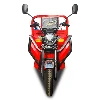
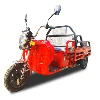
HANXUE HANMA (汗血悍马), a Chongqing-based manufacturer, illustrates the pattern. Its electric three-wheeled motorcycles in the 409th MIIT announcement batch include the HX1500DZH cargo model, with a rated payload of 195 kg, and the three-seat HX1500DZK, both using a 1.5 kW motor and a design top speed of 51 km/h. The company exports to more than 40 countries and regions, where customization for local roads, loads and climate is a standard part of the order, not an exception.
Outlook
Electric three-wheelers are not a transitional product. They are the lowest-cost motorised answer to a permanent problem: moving a few hundred kilograms a few dozen kilometres, repeatedly, at a price a small operator can afford. The constraints ahead are real - battery cost, charging access, intensifying price competition and a market where many products look alike - but they are constraints on execution, not on the underlying case.
For fleets and owner-operators weighing a switch, the arithmetic has rarely been clearer.