Rugged dirt roads and underdeveloped rural transportation have long been major bottlenecks restricting agricultural development and household income growth across rural areas in Zimbabwe, Tanzania, and other African countries. For decades, local farmers relied entirely on manual labor and simple handcart transport to harvest and deliver crops. Such traditional methods feature low carrying capacity, low efficiency and high commodity loss rates, often causing fresh vegetables, fruits and grain products to spoil before reaching markets. Today, cost-effective, terrain-adaptable and easy-to-operate Chinese electric tricycles are widely deployed in rural Africa, thoroughly upgrading local agricultural transportation models. Serving as a powerful tool for local farmers to increase income, Chinese manufacturing has once again demonstrated strong competitiveness in global sinking markets.
Anna, a mother of three living in a remote rural area of Zimbabwe, is one of the earliest beneficiaries of Chinese electric tricycles. In local villages, women undertake more than 60 percent of farm work and household chores, with crop transportation being the most labor-intensive part. During harvest seasons, Anna and other local farmers used to carry cabbages, sweet potatoes, corn and other crops on their heads and shoulders, walking several kilometers to village markets. Each trip could carry less than 50 kilograms of produce and take nearly two hours round trip. The exhausting manual transportation was extremely inefficient. In rainy seasons, muddy and slippery roads further increased crop damage. Restricted by limited transportation radius, farmers could only sell their produce at low prices in local villages, unable to deliver high-quality goods to township markets more than ten kilometers away, leaving them with no way to boost income.
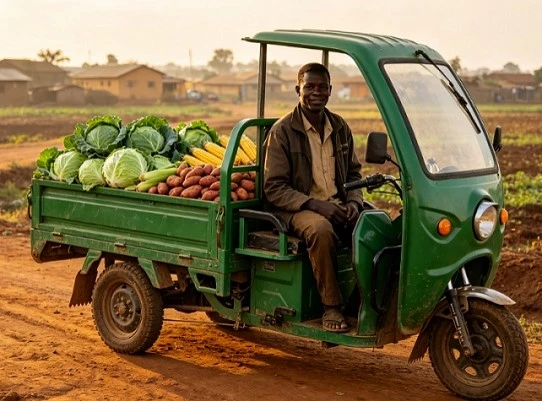
This long-standing dilemma has been completely resolved by the popularization of Chinese electric tricycles. Compared with expensive second-hand cars and impractical agricultural equipment available locally, Chinese electric tricycles are affordably priced, costing only a few hundred US dollars, which perfectly matches the consumption capacity of African rural households. Optimized for rough, muddy rural roads in Africa, these tricycles adopt sturdy and wear-resistant frames, high-power motors and excellent climbing performance to adapt to complex local road conditions. Featuring simple operation and convenient maintenance, they can be easily operated by novice farmers after basic training.
Cargo-type electric tricycles have brought a qualitative leap in local transportation efficiency. According to Anna, her daily manual transportation volume was less than 250 kilograms with 3 to 4 round trips at most. In contrast, a Chinese electric tricycle can carry over 50 cabbages or equivalent bulk crops in a single trip, boosting daily transportation efficiency by more than 10 times and reaching township markets 15 kilometers away in just half an hour. The greatly improved efficiency significantly reduces crop loss and ensures fresh agricultural products reach the market in good condition. Manual labor is fully liberated: a full day's traditional transportation work can now be finished in half a day, allowing farmers more time for field management and side businesses.

The expanded transportation radius has effectively opened up income growth channels for local farmers. Oversupply in small village markets once kept purchase prices extremely low. With the flexible transportation support of electric tricycles, farmers can now deliver high-quality produce to township and county markets, raising sales revenue by more than 30 percent. Beyond agricultural transportation, the multi-functional tricycles also meet daily needs including water fetching, material delivery and short-distance passenger transport. Versatile and cost-efficient, they have become an all-round helper for rural life, farming and income generation. Many rural women like Anna have launched small independent transportation businesses with the tricycles, breaking free from strenuous manual labor, achieving financial independence and enhancing their family status and social influence.
The market penetration of Chinese electric tricycles is accelerating across major agricultural countries in Africa, including Tanzania, Kenya and Nigeria. Many rural communities have set up women-led tricycle transport teams, providing agricultural delivery and daily transportation services for villagers, earning them the local reputation of "rural mobile stations". In remote villages of Kagera, Tanzania, local farmers have built a preliminary rural short-distance logistics system relying on Chinese electric tricycles, enabling the rapid circulation of fruits, fresh milk, grain and other agricultural products and completely solving the long-standing problem of "quality local products failing to reach external markets".
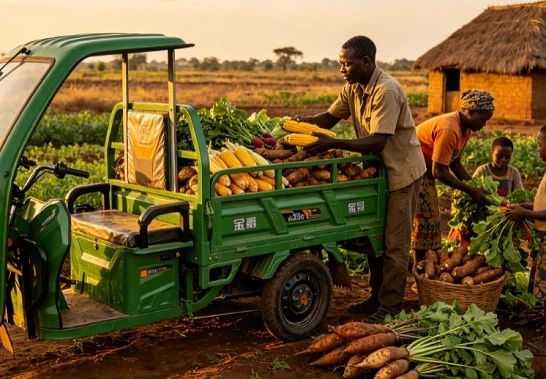
The global popularity of Chinese electric tricycles as a core equipment empowering African rural agriculture rather than just low-end transport tools is no coincidence. Compared with traditional fuel vehicles, electric tricycles feature low operation costs and eco-friendly performance, requiring no complex fuel supply facilities, which perfectly fits the infrastructure conditions of rural Africa. In addition, Chinese manufacturers continue to deepen overseas market segmentation. They optimize vehicle configurations targeting local demands such as heavy-load operation, harsh road conditions and high-temperature humid environments, upgrading frame anti-rust performance, motor load capacity and battery durability to launch highly adaptable and reliable customized models for Africa.
Industry statistics show that China's export volume of electric tricycles to Africa has maintained steady growth in recent years, with rural agricultural and cargo models occupying the dominant market share. With the accelerated modernization of African rural agriculture and continuous improvement of rural infrastructure, low-cost, highly adaptable and multi-functional Chinese electric tricycles will continue to fill the gap in rural short-distance transportation markets. In the future, Chinese tricycle manufacturers will further optimize customized overseas products and improve localized after-sales systems. With reliable manufacturing strength and scenario-oriented product solutions, Chinese brands will keep empowering African rural economic development and consolidating the competitive advantages of Chinese manufacturing in global sinking markets and cross-border livelihood industries.