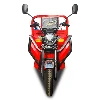
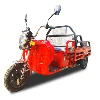
In the intricate web of urban and rural economic and social life, gasoline-powered tricycles, with their unique performance combination and adaptability to various scenarios, firmly occupy a key position in the grassroots transportation network. They are not vehicles pursuing high speed and luxury, but rather, based on "reliability, economy, and flexibility," they play an irreplaceable supporting role in agricultural production, commerce, and public services.
From a functional perspective, the core design philosophy of gasoline-powered tricycles is "practicality first." Their single-cylinder or twin-cylinder gasoline engines possess low-speed, high-torque characteristics, allowing them to smoothly handle slopes, mud, and unpaved roads even when fully loaded. The stable range of fuel-powered vehicles also eliminates the limitations of charging infrastructure, becoming a fundamental guarantee for "being able to move" in rural and mountainous areas with weak power grids. The three-wheeled structure, through the balance of front-wheel steering and rear dual-wheel load-bearing, ensures vehicle stability under heavy loads while allowing for flexible maneuverability through narrow streets and field ridges with its compact front compartment. Flatbed, sideboard, or simple box-type cargo boxes can be adjusted as needed to adapt to diverse loading requirements such as agricultural supplies, building materials, and daily necessities.
At the application level, its value permeates multiple dimensions of grassroots operations. In agricultural production, it serves as a "mobile warehouse" for agricultural supplies going down the supply chain and a "first-launch carrier" for agricultural products going up, shortening the distance between production and sales and reducing the intensity of manual handling. In urban and rural logistics, it bridges the gaps in traditional transportation networks with flexible "last-mile" delivery, making it more efficient for urban goods to enter rural areas and agricultural products to enter cities. In the public service sector, modified sanitation and engineering vehicles can quickly respond to cleaning and repair needs, and in emergency scenarios, its mobility (ready to refuel and go) makes it a reliable supplement for material transfer.
Economic efficiency is also a key strength. The mature structure and widespread availability of spare parts make the purchase and maintenance costs far lower than those of four-wheeled motor vehicles. Fuel replenishment relies on the existing gas station network, making it extremely friendly to small and medium-sized operators and individual farmers. This "low-barrier, high-reliability" characteristic not only activates the flexibility of grassroots employment but also drives skills training and the micro-circulation of the rural economy through a localized maintenance service chain.
As a "pragmatic pillar" of grassroots transportation, gasoline-powered tricycles, with their deep adaptability to complex working conditions and precise response to people's needs, continue to inject steady momentum into urban-rural integration and development. Their value will become increasingly prominent as the vitality of the grassroots economy is unleashed.